What the leader sees
Work has clear ownership. Scope changes are understood. A difficult conversation is resolved.
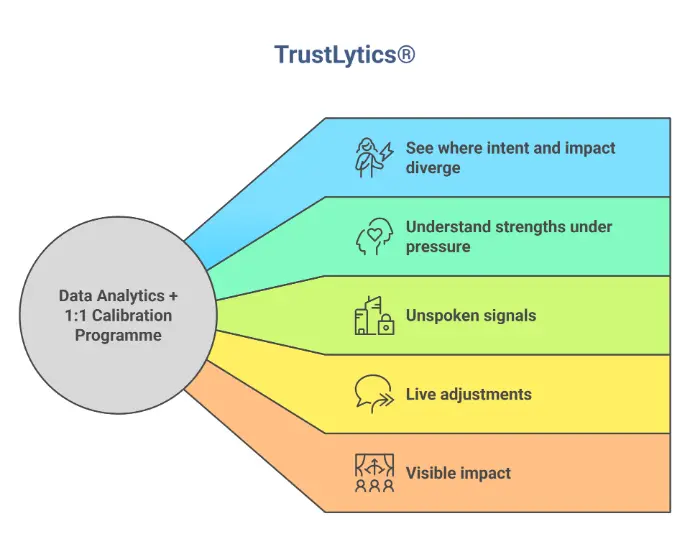
TrustLytics® compares how leaders understand the working environment with how the people around them actually experience it.
Start with the Blind Spot DiagnosticLeaders make decisions from the information they can see.
Teams experience the consequences of those decisions in the work itself.
Work has clear ownership. Scope changes are understood. A difficult conversation is resolved.
Bottlenecks repeat. Unclear briefs absorb cost. The conversation lands differently.
TrustLytics combines anonymised team level information with focused one to one calibration around the situations that matter most.
Repeated revisions, write-downs and rework can signal a gap between how clearly work was believed to be communicated and how clearly it was understood.
Senior people can become permanent problem solvers when responsibility, escalation and ownership are experienced differently.
Changes in scope, late escalation and unclear follow through often become visible only when a deadline is under pressure.
Small repeated experiences can compound for months before attrition appears in the numbers.
Identify situations where what was intended and what the team experienced do not appear to be the same.
Explore how high standards, decisiveness or composure can create friction when overused in particular situations.
Recognise patterns such as hesitation, silence, checking or late escalation that can replace direct feedback.
Test small, precise changes in real work, real decisions and real conversations rather than hypothetical exercises.
Notice the signals in the working environment as the gap becomes clearer, without treating any outcome as guaranteed.
The Blind Spot Diagnostic establishes how the leader currently reads the operating environment and highlights areas worth examining more closely.
Relevant team members provide structured, anonymised responses about the same kinds of operational situations.
Thomas Telman examines where leadership perception and team experience align, and where they materially diverge.
The findings are considered alongside billing friction, lost capacity, avoidable rework, delayed delivery and retention risk.
The result is a clearer idea of what needs to change in the work itself, rather than a generic programme or personality label.
Focused 1:1 coaching sessions work directly with live matters and real situations, testing small adjustments in how leaders take ownership, review, communicate and respond under pressure.
The same blind spots can be revisited to establish whether the gap between leadership intent and team experience is reducing.
It examines specific operational situations, rather than broad sentiment across a firm.
The focus stays on observable work, communication and decision making.
It identifies the problem before deciding what intervention makes sense.
The purpose is not to prove one perspective right, but to find where the difference matters.
TrustLytics® is designed for managing partners, partners and COOs in law and accountancy firms where margin, delivery consistency and retention depend heavily on how work moves between people. It is especially useful when leadership responsibility has increased and something appears to be affecting performance but the source is not obvious.
Margins or utilisation do not feel as strong as they should.
Senior people are repeatedly pulled into work that should happen elsewhere.
Problems tend to become visible later than expected.
The team is experiencing pressure that leadership cannot fully explain.
Retention, write-downs or delivery issues recur despite previous attempts to address them.
The wrong problem can look like the right one. TrustLytics® brings the leader view and team experience together so the next decision starts from a clearer picture.