
Originally published on LinkedIn on 7 May 2026.
Most managing partners know their KPI’s umber very well. Realisation rates, PEP, utilisation however what it doesn’t show them is what is sitting behind it. The numbers look strong but strong numbers have a way of masking what is quietly building beneath them. The leadership blind spots that don’t show up until the metrics start to move.
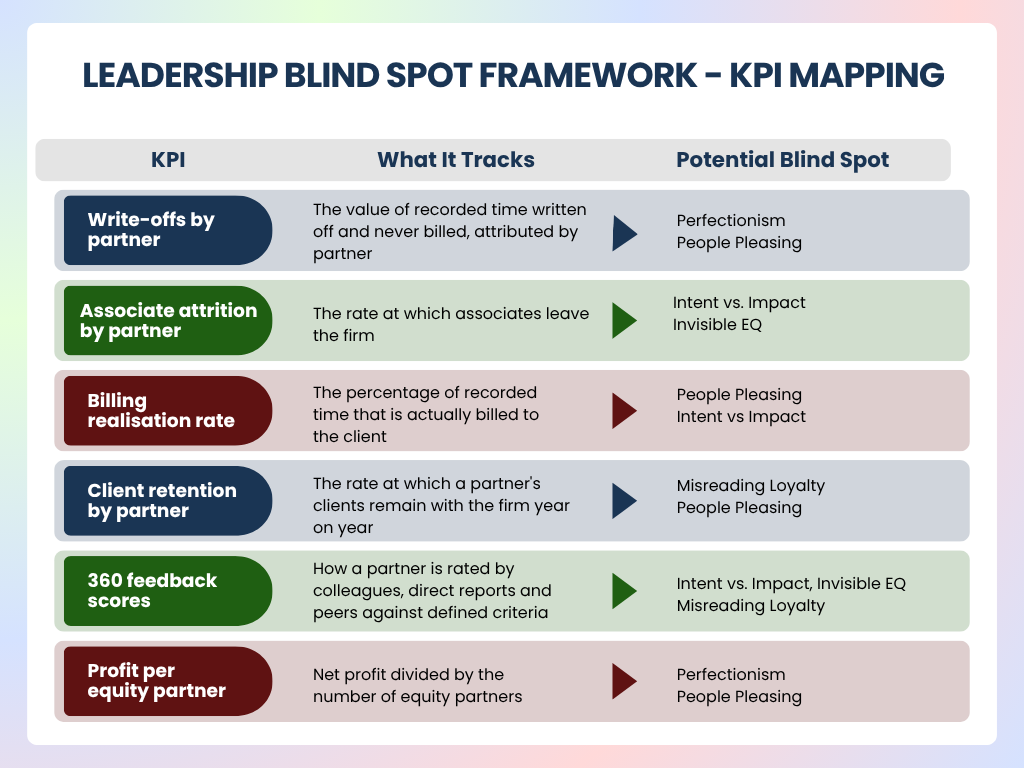
This brief introduces The Leader’s Blind Spot Framework. It maps the KPIs you already track to the six leadership patterns underneath them.
Why This Matters: The Cost of Not Looking
Blind spots operate the way a slow puncture does, invisible until the vehicle is already pulling to one side and costs are increasing. It shows up in the associate who left and took three client relationships with them. The client who moved their work without a phone call. The institutional knowledge that walked out of the door on a Friday afternoon and never came back.
None of it looks significant in any single month however across a financial year, it adds up.
What Happens When Blind Spots Go Unexamined
Revenue doesn’t collapse. It seeps. Write-offs accumulate. WIP ages. Realisation drifts. The firm finds itself spending more to recruit than it ever spent to retain. Productivity falls, not dramatically, not in a way that triggers a conversation, but measurably, in output and in billing, over time.
The Six Blind Spots
We all have blind spots because we are human. They are not personality flaws or a criticism of one’s character, but they are adaptive patterns and often are the very traits that made partners successful, that have become the firm’s most expensive habits.
1. Perfectionism
When the standard for ‘good enough to release’ keeps moving, the cost is invisible but it shows up in write-offs, stalled matters, and associates who feel they aren’t trusted and lack autonomy. The blind spot is not the commitment to quality. It’s the inability to judge when it has been achieved.
2. People Pleasing
The leader who struggles to have a hard conversation with a client, colleague or team member about scope, fees, or underperformance but instead absorbs the cost personally and institutionally. The relationship feels strong but the boundaries that protect the firm’s margins are quietly breached.
3. Intent vs. Impact
A partner who believes they are leading well but whose people feel undervalued, unclear or unseen is operating on intent alone. Impact is the reality that shows up in performance, retention and billing.
4. Self-Neglect
The unconscious habit and often prideful failure of a leader to prioritise their own physical, mental, and emotional wellbeing. They mistake burnout for noble sacrifice and say things like, “I’m fine, I just need to get through this quarter” or “this is just what leadership looks like.”
5. Invisible Emotional Intelligence
A leader who is fundamentally unable to perceive the subtle, unspoken signals that reveal how others are actually feeling and has no awareness they are missing anything at all. It’s not indifference. It’s an absence of signal.
6. Misreading Loyalty
Leaders who mistake longevity for commitment. An associate who has not complained about workload is not necessarily engaged. A client who has not left is not necessarily loyal. They are a retention risk that does not yet appear in your data.
The Leader’s Blind Spot Framework: KPI Mapping
Blind spots usually operate in clusters. The same KPI will often carry the fingerprint of more than one. The framework identifies the pattern and tells you where to intervene.
The question is not whether your firm has blind spots. Every firm does. The question is how quickly you can see them.
The Leadership Blind Spot Brief is published weekly for senior leaders in UK law firms. If a colleague forwarded this, you can subscribe directly on LinkedIn and if it’s useful, pass it on to one person in your network who runs a firm.
Andre Thomas is the founder of Thomas Telman and the creator of TrustLytics®, a risk management system designed to help law firm leaders surface and close the blind spots affecting the firm’s performance and profitability. He works with professional services firms across the UK. You can find out more at thomastelman.com